Most people don’t think too much about tracking when they first get into affiliate marketing.
At the beginning, things feel simple enough. One offer, a couple of landing pages, a few campaigns running in the background. You check the affiliate dashboard, look at clicks and conversions, maybe update a spreadsheet, and it feels like you understand what’s going on. For a while, that’s usually enough.
If you’re still getting familiar with affiliate marketing terminology, it’s worth starting with our [Affiliate Marketing for Beginners: From Offers to Conversions — Essential Terms and Metrics Explained] guide, which covers the basic terms and performance metrics you’ll encounter before getting into tracking and campaign optimization.
But things change quickly once paid traffic enters the picture.
When you start running multiple campaigns across different traffic sources, everything becomes more fragmented. One campaign might perform well on Android but poorly on iOS. One publisher sends thousands of clicks but no conversions. Some GEOs look profitable at first, then slowly turn negative without any obvious reason. And the frustrating part is that none of this is immediately visible.
Traffic doesn’t usually break in a clear way. It leaks slowly. Budget gets spent on placements you didn’t expect, bot traffic slips through, redirects are slightly slower than they should be, and data becomes harder to interpret as campaigns scale.
That’s usually the point where tracking stops being “optional”.
Why Tracking Becomes Critical in Paid Traffic
Most beginners focus on offers and creatives, which is completely normal. But after running enough campaigns, you start to realize something simple: the ability to read traffic properly is often more important than the offer itself. A proper affiliate tracker helps you understand:
- where conversions actually come from
- which placements are wasting money
- how users behave across devices and GEOs
- whether traffic quality is consistent
- how fast redirects are performing
- and where bot traffic might be hiding
Without that level of visibility, scaling becomes guesswork.
I still remember one early campaign where everything looked fine on the surface. Good CTR, stable traffic, normal CPC. But once I looked at the data inside a tracker, a large portion of the spend was coming from placements that never converted at all. Without that visibility, I would have kept scaling a losing campaign.
That’s the kind of thing you only notice when tracking is properly set up.
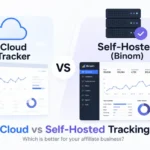
Cloud Trackers vs Self-Hosted Trackers
Most affiliate trackers fall into two categories:
- cloud-based trackers
- self-hosted trackers
Cloud trackers are usually easier to start with.
Platforms like Voluum or Bemob remove most of the technical work. You sign up, add campaigns, configure postbacks, and start tracking almost immediately.
No server setup.
No VPS configuration.
No database tuning.
For beginners, that simplicity is valuable. But as campaigns grow, priorities shift. Monthly costs increase with traffic volume. Redirect speed becomes more noticeable. Some affiliates want more control over routing logic, logs, filtering, and infrastructure performance.
That’s usually where self-hosted trackers start becoming more attractive.
Why Many Affiliates Move to Binom
Among self-hosted solutions, Binom is one of the most widely used tools in performance marketing.
It is built for speed and simplicity rather than polished UI design. The interface feels direct, sometimes even minimal, but that’s exactly why many media buyers prefer it. When you are running paid traffic at scale, what matters is not how the dashboard looks, but how fast and reliable the system is. With Binom, the entire tracking system runs on your own VPS.
That means you control:
- server performance
- database optimization
- redirect speed
- traffic routing rules
- logs and data storage
- filtering logic
For many affiliates, this level of control becomes important once traffic volume increases.
Another key factor is cost stability. Unlike cloud trackers that scale monthly pricing with usage, a self-hosted setup can remain relatively stable over time once deployed properly. That means no increasing subscription fees just because your traffic grows.
If you are new to Binom or self-hosted tracking in general, I wrote a separate beginner-friendly guide that walks through the full configuration process step by step. The King of Trackers — A Complete Binom Configuration Guide for Beginners
It covers the full setup process from installation to basic configuration, which can make everything in this article much easier to understand.
The Long-Term Advantage of Self-Hosted Tracking
One thing I’ve noticed over time is that self-hosted tracking is not just about control, but also about removing long-term friction.
Most experienced media buyers eventually care about:
- predictable infrastructure costs
- consistent performance
- full ownership of data
- faster redirect handling
- flexible routing logic
In other words, they want fewer external dependencies. This is also why many affiliates eventually move away from “all-in-one SaaS dashboards” and prefer systems they can fully control.
Not Everyone Needs Self-Hosted Tracking
To be fair, cloud trackers still make a lot of sense for beginners. If you are just testing campaigns or learning how affiliate marketing works, tools like Voluum or Bemob are usually more than enough. They remove the technical barrier and let you focus on traffic and offers.
But once you start scaling paid traffic seriously, tracking becomes part of your infrastructure, not just a reporting tool. At that point, control, speed, and long-term cost structure start to matter more than convenience.
A Simpler Way to Use Binom
One of the biggest challenges with self-hosted trackers is not the software itself, but the setup process. A lot of affiliates want to use Binom, but get stuck at the deployment stage. VPS setup, database configuration, SSL installation, permissions, and server optimization often turn into a time-consuming technical task. Not everyone wants to spend time debugging Linux servers instead of optimizing campaigns.
That’s partly why I created binom.vip.
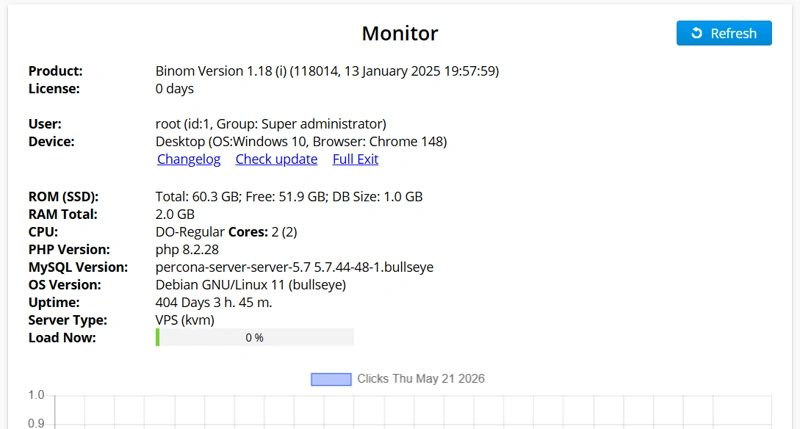
It’s a simple installation service for affiliates who want to run Binom on their own VPS without dealing with the technical setup process. The idea is straightforward:
One installation.
A clean working environment.
Long-term usage on your own server.
No repeated setup work.
No unnecessary complexity.
Just a ready-to-use self-hosted tracking system.
A lot of people spend most of their time focusing on offers, creatives, and traffic sources, while tracking is often treated as something secondary. But once campaigns start scaling, tracking quietly becomes one of the most important parts of the entire system.
Not the most exciting part. But often the one that determines whether scaling is actually sustainable.